This week saw lots of new props and decorative assets, but the biggest jump was the light tests, which show new opportunities for making our environments look better than ever.
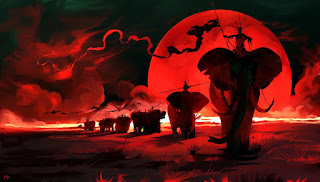
Welcome! This is the start of Michael Manfredi's Capstone Development Blog, where you can get a closer look at the artistic progress occurring on the Phantasm Team. This week, the main priority was about finding a simple style that lent was appealing to the eye but had a speedy workflow. I wanted to emulate the intense colors present in images like these, by Dominik Mayer and Halil Ural, respectively: They provide striking color and contrast. I did some experimentation with color clashing in these brief thumbnails. Finally, I did some tests in Unreal to see if the style could be emulated in engine, and I think despite no post processing edits and basic building block objects, the results were quite successful. After these experiments, I think we can utilize this style effectively by having semi detailed modeling and simple, color focused textures.
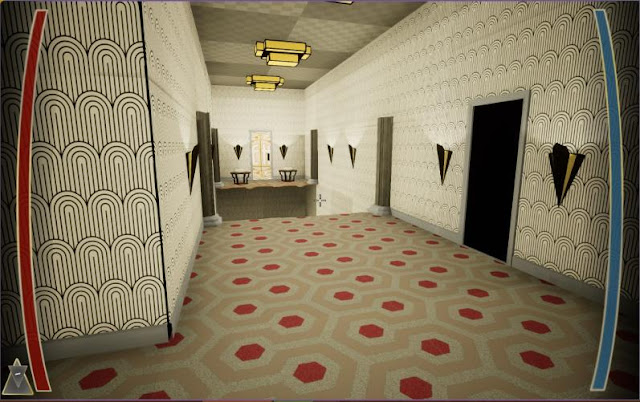
This week, a number of tasks lay before me. -Create assets for the Heads Up Display... -Create a final character asset that the enemy shader could be applied to... -Make some flashy art for our next presentation... -And finally, spend whatever remaining time I had making new assets that would work in various settings such as lounges, halls and lobbies- and then using said assets to polish existing levels. Fortunately, the HUD and character took significantly less time than it could have. The general layout of the health, energy and corner spaces (which can hold numbers for collectables or other information) are meant to be as out-of-the-way as possible, complemented by the vignette effect on either side of the screen. The vignetting also helps suggest the player is indeed wearing the mask, which is a pivotal part of the narrative, and helps make the game feel a bit more claustrophobic and cramped. Much inspiration for the overall shape was taken from...
As I float towards Re[Mod], I think back on our attempted game, Empirical, and wonder what could have been. It certainly was a high-scope project- essentially the scale of a single level from Bioshock- and we got closer than I could have imagined to achieving the goal. I can't really speak on the challenges Amos and Kai, the designers faced. Nor can I touch the programming difficulties. My understanding and specialty lies solely within the realm of the art, and the Environment. In that regard, I am quite proud of the end result. Early in the process, the main objective of figuring out exactly how such a large area could be modeled, constructed and polished by one person, was quite the mystery. Thanks to a well crafted pipeline I think not only did we manage to build a believable space, I also think we created a place that has a sense of genuine atmospheric dread. I would have loved to have an animator, of course, as the enemies are quite... stiff. But I think the ...


Comments
Post a Comment